


















-
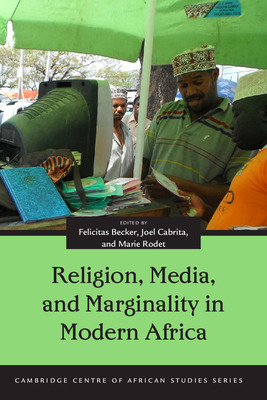
Religion, Media, and Marginality in Modern Africa
Felicitas Becker, Joel Cabrita, and Marie Rodet
In recent years, anthropologists, historians, and others have been drawn to study the profuse and creative usages of digital media by religious movements. At the same time, scholars of Christian Africa have long been concerned with the history of textual culture, the politics of Bible translation, and the status of the vernacular in Christianity. Students of Islam in Africa have similarly examined politics of knowledge, the transmission of learning in written form, and the influence of new media. Until now, however, these arenas—Christianity and Islam, digital media and “old” media—have been studied separately.
Religion, Media, and Marginality in Modern Africa is one of the first volumes to put new media and old media into significant conversation with one another, and also offers a rare comparison between Christianity and Islam in Africa. The contributors find many previously unacknowledged correspondences among different media and between the two faiths. In the process they challenge the technological determinism—the notion that certain types of media generate particular forms of religious expression—that haunts many studies. In evaluating how media usage and religious commitment intersect in the social, cultural, and political landscapes of modern Africa, this collection will contribute to the development of new paradigms for media and religious studies.
Contributors: Heike Behrend, Andre Chappatte, Maria Frahm-Arp, David Gordon, Liz Gunner, Bruce S. Hall, Sean Hanretta, Jorg Haustein, Katrien Pype, and Asonzeh Ukah. -
Research as More Than Extraction : Knowledge Production and Gender-Based Violence in African Societies
Annie Bunting, Allen Kiconco, and Joel Quirk
This volume offers practical, detailed guidance and case studies on how to avoid exacerbating inequalities while researching gender-based violence and other related issues in Africa.
Wartime violence and its aftermath present numerous practical, ethical, and political challenges that are especially acute for researchers working on gender-based and sexual violence. Drawing upon applied examples from across the African continent, this volume features unique contributions from researchers and practitioners with decades of experience developing research partnerships, designing and undertaking fieldwork, asking sensitive questions, negotiating access, collecting and evaluating information, and validating results. These are all endeavors that also raise pressing ethical questions, especially in relation to retraumatization, social stigma, and even payment of participants.
Ethical and methodological questions cannot be separated from political and institutional considerations. Systems of privilege and marginalization cannot be wished away, so they need to be both interrogated and contested. This is where precedents and power relations established under colonialism and imperialism take center stage. Europeans have been extracting valuable resources from the African continent for centuries. Research into gender-based violence risks being yet another extractive industry. There are times when committed individuals can make valuable contributions to a more equitable future, but funding streams, knowledge hierarchies, and institutional positions continue to have powerful effects.
Accordingly, the contributors to this volume also concentrate upon the layered effects of power and position, relationships between researchers, organizations, and communities, and the political economy of knowledge production; this brings into focus questions about how and why information gets generated, for which kinds of audiences, and for whose benefit. -

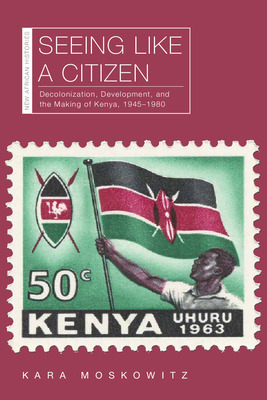
Seeing Like a Citizen : Decolonization, Development, and the Making of Kenya, 1945–1980
Kara Moskowitz
In Seeing Like a Citizen, Kara Moskowitz approaches Kenya’s late colonial and early postcolonial eras as a single period of political, economic, and social transition. In focusing on rural Kenyans—the vast majority of the populace and the main targets of development interventions—as they actively sought access to aid, she offers new insights into the texture of political life in decolonizing Kenya and the early postcolonial world.
Using multisited archival sources and oral histories focused on the western Rift Valley, Seeing Like a Citizen makes three fundamental contributions to our understanding of African and Kenyan history. First, it challenges the widely accepted idea of the gatekeeper state, revealing that state control remained limited and that the postcolonial state was an internally varied and often dissonant institution. Second, it transforms our understanding of postcolonial citizenship, showing that its balance of rights and duties was neither claimed nor imposed, but negotiated and differentiated. Third, it reorients Kenyan historiography away from central Kenya and elite postcolonial politics. The result is a powerful investigation of experiences of independence, of the meaning and form of development, and of how global political practices were composed and recomposed on the ground in local settings. -

Settling Ohio: First Peoples and Beyond
Timothy G. Anderson and Brian Schoen
Scholars working in archaeology, education, history, geography, and politics tell a nuanced story about the people and dynamics that reshaped this region and determined who would control it.
The Ohio Valley possesses some of the most resource-rich terrain in the world. Its settlement by humans was thus consequential not only for shaping the geographic and cultural landscape of the region but also for forming the United States and the future of world history.
Settling Ohio begins with an overview of the first people who inhabited the region, who built civilizations that moved massive amounts of earth and left an archaeological record that drew the interest of subsequent settlers and continues to intrigue scholars. It highlights how, in the eighteenth century, Native Americans who migrated from the East and North interacted with Europeans to develop impressive trading networks and how they navigated complicated wars and sought to preserve national identities in the face of violent attempts to remove them from their lands.
The book situates the traditional story of Ohio settlement, including the Northwest Ordinance, the dealings of the Ohio Company of Associates, and early road building, into a far richer story of contested spaces, competing visions of nationhood, and complicated relations with Indian peoples. By so doing, the contributors provide valuable new insights into how chaotic and contingent early national politics and frontier development truly were. Chapters highlighting the role of apple-growing culture, education, African American settlers, and the diverse migration flows into Ohio from the East and Europe further demonstrate the complex multiethnic composition of Ohio’s early settlements and the tensions that resulted.
A final theme of this volume is the desirability of working to recover the often-forgotten history of non-White peoples displaced by the processes of settler colonialism that has been, until recently, undervalued in the scholarship. -
Sex, Power, and Slavery
Gwyn Campbell and Elizabeth Elbourne
Sexual exploitation was and is a critical feature of enslavement. Across many different societies, slaves were considered to own neither their bodies nor their children, even if many struggled to resist. At the same time, paradoxes abound: for example, in some societies to bear the children of a master was a potential route to manumission for some women. Sex, Power, and Slavery is the first history of slavery and bondage to take sexuality seriously.
Twenty-six authors from diverse scholarly backgrounds look at the vexed, traumatic intersections of the histories of slavery and of sexuality. They argue that such intersections mattered profoundly and, indeed, that slavery cannot be understood without adequate attention to sexuality. Sex, Power, and Slavery brings into conversation historians of the slave trade, art historians, and scholars of childhood and contemporary sex trafficking. The book merges work on the Atlantic world and the Indian Ocean world and enables rich comparisons and parallels between these diverse areas.
Contributors: David Brion Davis, Martin Klein, Richard Hellie, Abdul Sheriff, Griet Vankeerberghen, E. Ann McDougall, Matthew S. Hopper, Marie Rodet, George La Rue, Ulrike Schmieder, Tara Iniss, Mariana Candido, James Francis Warren, Johanna Ransmeier, Roseline Uyanga with Marie-Luise Ermisch, Francesca Ann Louise Mitchell, Shigeru Sato, Gabeba Baderoon, Charmaine Nelson, Ana Lucia Araujo, Brian Lewis, Ronaldo Vainfas, Salah Trabelsi, Joost Coté, Sandra Evers, and Subho Basu
-
Slavery, Agriculture, and Malaria in the Arabian Peninsula
Benjamin Reilly
In Slavery, Agriculture, and Malaria in the Arabian Peninsula, Benjamin Reilly illuminates a previously unstudied phenomenon: the large-scale employment of people of African ancestry as slaves in agricultural oases within the Arabian Peninsula. The key to understanding this unusual system, Reilly argues, is the prevalence of malaria within Arabian Peninsula oases and drainage basins, which rendered agricultural lands in Arabia extremely unhealthy for people without genetic or acquired resistance to malarial fevers. In this way, Arabian slave agriculture had unexpected similarities to slavery as practiced in the Caribbean and Brazil.
This book synthesizes for the first time a body of historical and ethnographic data about slave-based agriculture in the Arabian Peninsula. Reilly uses an innovative methodology to analyze the limited historical record and a multidisciplinary approach to complicate our understandings of the nature of work in an area that is popularly thought of solely as desert. This work makes significant contributions both to the global literature on slavery and to the environmental history of the Middle East—an area that has thus far received little attention from scholars.
-
South Sudan : A New History for a New Nation
Douglas H. Johnson
Africa’s newest nation has a long history. Often considered remote and isolated from the rest of Africa, and usually associated with the violence of slavery and civil war, South Sudan has been an arena for a complex mixing of peoples, languages, and beliefs. The nation’s diversity is both its strength and a challenge as its people attempt to overcome the legacy of decades of war to build a new economic, political, and national future.
Most recent studies of South Sudan’s history have a foreshortened sense of the past, focusing on current political issues, the recently ended civil war, or the ongoing conflicts within the country and along its border with Sudan. This brief but substantial overview of South Sudan’s longue durée, by one of the world’s foremost experts on the region, answers the need for a current, accessible book on this important country.
Drawing on recent advances in the archaeology of the Nile Valley, new fieldwork as well as classic ethnography, and local and foreign archives, Johnson recovers South Sudan’s place in African history and challenges the stereotypes imposed on its peoples.
-

Sports in Africa, Past and Present
Todd Cleveland, Tarminder Kaur, and Gerard Akindes
These groundbreaking essays demonstrate how Africans past and present have utilized sports to forge complex identities and shape Africa’s dynamic place in the world.
Since the late nineteenth century, modern sports in Africa have both reflected and shaped cultural, social, political, economic, generational, and gender relations on the continent. Although colonial powers originally introduced European sports as a means of “civilizing” indigenous populations and upholding then current notions of racial hierarchies and “muscular Christianity,” Africans quickly appropriated these sporting practices to fulfill their own varied interests. This collection encompasses a wide range of topics, including women footballers in Nigeria, Kenya’s world-class long-distance runners, pitches and stadiums in communities large and small, fandom and pay-to-watch kiosks, the sporting diaspora, sports pedagogy, sports as resistance and as a means to forge identity, sports heritage, the impact of politics on sports, and sporting biography.Award: North American Society for Sport History Book Prize
-
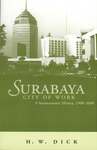
Surabaya, City of Work: A Socioeconomic History, 1900–2000
Howard Dick
Surabaya is Indonesia’s second largest city but is not well known to the outside world. Yet in 1900, Surabaya was a bigger city than Jakarta and one of the main commercial centers of Asia. Collapse of sugar exports during the 1930s depression, followed by the Japanese occupation, revolution, and independence, brought on a long period of stagnation and retreat from the international economy. Not until the export boom of the 1990s did Surabaya regain prominence as Southeast Asia’s leading non–capital–city industrial area. Previous thinking on Indonesia is being reassessed in light of recent political and economic upheaval. Surabaya, City of Work offers an alternative to the Jakarta-centric focus of most writing on the country. It is a multifaceted view of a fascinating and complex city in the dimensions of time and space, economy and society, and the current transition toward decentralization makes it highly topical. Exploration of this eventful economic history gives new insight into Indonesia’s modern economic development. Industrialization is recognized as being associated with rapid urbanization, but this is the first study of Indonesia from an explicitly urban perspective. Surabaya, City of Work takes a broad approach that links industrialization to socioeconomic trends, the increasing role of government, changing land use, and trade patterns. This well–illustrated local history encompassing national events and trends will be a central work on Indonesia for years to come.
-
Technologies of Suspicion and the Ethics of Obligation in Political Asylum
Bridget M. Haas and Amy Shuman
Across the globe, migration has been met with intensifying modes of criminalization and securitization, and claims for political asylum are increasingly met with suspicion. Asylum seekers have become the focus of global debates surrounding humanitarian obligations, on the one hand, and concerns surrounding national security and border control, on the other. In Technologies of Suspicion and the Ethics of Obligation in Political Asylum, contributors provide fine-tuned analyses of political asylum systems and the adjudication of asylum claims across a range of sociocultural and geopolitical contexts.
The contributors to this timely volume, drawing on a variety of theoretical perspectives, offer critical insights into the processes by which tensions between humanitarianism and security are negotiated at the local level, often with negative consequences for asylum seekers. By investigating how a politics of suspicion within asylum systems is enacted in everyday practices and interactions, the authors illustrate how asylum seekers are often produced as suspicious subjects by the very systems to which they appeal for protection.
Contributors: Ilil Benjamin, Carol Bohmer, Nadia El-Shaarawi, Bridget M. Haas, John Beard Haviland, Marco Jacquemet, Benjamin N. Lawrance, Rachel Lewis, Sara McKinnon, Amy Shuman, Charles Watters
-
Temple of Peace : International Cooperation and Stability since 1945
Ingo Trauschweizer
This collection raises timely questions about peace and stability as it interrogates the past and present status of international relations.
The post–World War II liberal international order, upheld by organizations such as the United Nations, the North Atlantic Treaty Organization, and similar alliances, aspired to ensure decades of collective security, economic stability, and the rule of law. All of this was a negotiated process that required compromise—and yet it did not make for a peaceful world.
When Winston Churchill referred to the UN framework as “the temple of peace” in his famous 1946 Iron Curtain speech, he maintained that international alliances could help provide necessary stability so free people could prosper, both economically and politically. Though the pillars of international order remain in place today, in a world defined as much by populism as protest, leaders in the United States no longer seem inclined to serve as the indispensable power in an alliance framework that is built on shared values, human rights, and an admixture of hard and soft power. In this book, nine scholars and practitioners of diplomacy explore both the successes and the flaws of international cooperation over the past seventy years. Collectively, the authors seek to address questions about how the liberal international order was built and what challenges it has faced, as well as to offer perspectives on what could be lost in a post-American world. -
The Affection in Between : From Common Sense to Sensing in Common
April Flakne
Exposing a fundamental but forgotten capacity to sense with others, this fresh approach to ethics centers on expressive, moving bodies in everyday affective encounters.
Common sense has yet to yield its golden promise: robust selves, a stable sense of reality, and bonds of solidarity. The Affection in Between argues that reimagining common sense involves tackling two intractable philosophical puzzles together: the problems of sensory integration and of “other minds.” Construing common sense as either an individual cognitive capacity or a communal body of beliefs and practices, as our tradition of philosophical and political thought has done for too long, constricts possibilities of self and other, ethics and politics. Neither register alone can evade political manipulation and deliver common ground between confident yet unavoidably porous selves.
April Flakne begins with a novel interpretation of the neglected Aristotelian concept of sunaisthesis, an embodied, interactive capacity to create overlapping meaning through the cultivation of a sensibility that is neither individual nor communal but unfolds between bodies in movement. Bolstering Aristotle’s concept with classical and contemporary phenomenology, including critical phenomenology, empirical theories of social cognition, and affect theory, Flakne offers fresh answers to a pressing and legitimate skepticism about selfhood and the role that ethics might play in countering disorientation and manufactured division. Through an exploration of the intimate experiences of birth, death, caregiving, and mourning, Flakne brings the ethical and political aspects of interembodied interaction home and into lived experience.Award: Symposium Book Award
-
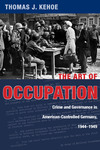
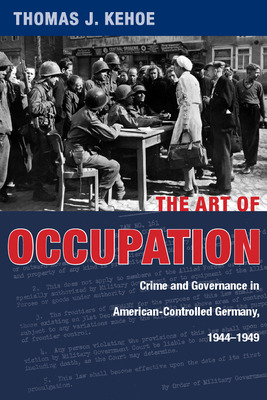
The Art of Occupation : Crime and Governance in American-Controlled Germany, 1944–1949
Thomas J. Kehoe
The literature describing social conditions during the post–World War II Allied occupation of Germany has been divided between seemingly irreconcilable assertions of prolonged criminal chaos and narratives of strict martial rule that precluded crime. In The Art of Occupation, Thomas J. Kehoe takes a different view on this history, addressing this divergence through an extensive, interdisciplinary analysis of the interaction between military government and social order.
Focusing on the American Zone and using previously unexamined American and German military reports, court records, and case files, Kehoe assesses crime rates and the psychology surrounding criminality. He thereby offers the first comprehensive exploration of criminality, policing, and both German and American fears around the realities of conquest and potential resistance, social and societal integrity, national futures, and a looming threat from communism in an emergent Cold War. The Art of Occupation is the fullest study of crime and governance during the five years from the first Allied incursions into Germany from the West in September 1944 through the end of the military occupation in 1949. It is an important contribution to American and German social, military, and police histories, as well as historical criminology.
-

The Autobiography of Daniel Parker, Frontier Universalist
Daniel Parker and David Torbett
A vastly informative and rare early-American pioneer autobiography rescued from obscurity.
In this remarkable memoir, Daniel Parker (1781–1861) recorded both the details of everyday life and the extraordinary historical events he witnessed west of the Appalachian Mountains between 1790 and 1840. Once a humble traveling salesman for a line of newly invented clothes washing machines, he became an outspoken advocate for abolition and education. With his wife and son, he founded Clermont Academy, a racially integrated, coeducational secondary school—the first of its kind in Ohio.
However, Parker’s real vocation was as a self-ordained, itinerant preacher of his own brand of universal salvation. Raised by Presbyterian parents, he experienced a dramatic conversion to the Halcyon Church, an alternative, millenarian religious movement led by the enigmatic prophet Abel Sarjent, in 1803. After parting ways with the Halcyonists, he continued his own biblical and theological studies, arriving at the universalist conclusions that he would eventually preach throughout the Ohio River Valley.
David Torbett has transcribed Parker’s manuscript and publishes it here for the first time, together with an introduction, epilogue, bibliography, and extensive notes that enrich and contextualize this rare pioneer autobiography.
-

The Emergence of the Moundbuilders: The Archaeology of Tribal Societies in Southeastern Ohio
Elliot Marc Abrams and AnnCorinne Freter
Native American societies, often viewed as unchanging, in fact experienced a rich process of cultural innovation in the millennia prior to recorded history. Societies of the Hocking River Valley in southeastern Ohio, part of the Ohio River Valley, created a tribal organization beginning about 2000 bc.
Edited by Elliot M. Abrams and AnnCorinne Freter, The Emergence of the Moundbuilders: The Archaeology of Tribal Societies in Southeastern Ohio presents the process of tribal formation and change in the region based on analyses of all available archaeological data from the Hocking River Valley. Drawing on the work of scholars in archaeology, anthropology, geography, geology, and botany, the collection addresses tribal society formation through such topics as the first pottery made in the valley, aggregate feasting by nomadic groups, the social context for burying their dead in earthen mounds, the formation of religious ceremonial centers, and the earliest adoption of corn. Providing the most current research on indigenous societies in the Hocking Valley, The Emergence of the Moundbuilders is distinguished by its broad, comparative overview of tribal life.
-

The Experiment Must Continue: Medical Research and Ethics in East Africa, 1940–2014
Melissa Graboyes
The Experiment Must Continue is a beautifully articulated ethnographic history of medical experimentation in East Africa from 1940 through 2014. In it, Melissa Graboyes combines her training in public health and in history to treat her subject with the dual sensitivities of a medical ethicist and a fine historian. She breathes life into the fascinating histories of research on human subjects, elucidating the hopes of the interventionists and the experiences of the putative beneficiaries.
Historical case studies highlight failed attempts to eliminate tropical diseases, while modern examples delve into ongoing malaria and HIV/AIDS research. Collectively, these show how East Africans have perceived research differently than researchers do and that the active participation of subjects led to the creation of a hybrid ethical form. By writing an ethnography of the past and a history of the present, Graboyes casts medical experimentation in a new light, and makes the resounding case that we must readjust our dominant ideas of consent, participation, and exploitation. With global implications, this lively book is as relevant for scholars as it is for anyone invested in the place of medicine in society.
-
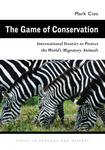
The Game of Conservation: International Treaties to Protect the World’s Migratory Animals
Mark Cioc
The Game of Conservation is a brilliantly crafted and highly readable examination of nature protection around the world.
Twentieth-century nature conservation treaties often originated as attempts to regulate the pace of killing rather than as attempts to protect animal habitat. Some were prompted by major breakthroughs in firearm techniques, such as the invention of the elephant gun and grenade harpoons, but agricultural development was at least as important as hunting regulations in determining the fate of migratory species. The treaties had many defects, yet they also served the goal of conservation to good effect, often saving key species from complete extermination and sometimes keeping the population numbers at viable levels. It is because of these treaties that Africa is dotted with large national parks, that North America has an extensive network of bird refuges, and that there are any whales left in the oceans. All of these treaties are still in effect today, and all continue to influence nature-protection efforts around the globe.
Drawing on a wide variety of primary and secondary sources, Mark Cioc shows that a handful of treaties—all designed to protect the world’s most commercially important migratory species—have largely shaped the contours of global nature conservation over the past century. The scope of the book ranges from the African savannahs and the skies of North America to the frigid waters of the Antarctic.
-
The Golden Age of Phenomenology at the New School for Social Research, 1954–1973
Lester Embree and Michael D. Barber
This collection focuses on the introduction of phenomenology to the United States by the community of scholars who taught and studied at the New School for Social Research from 1954 through 1973. During those years, Dorion Cairns, Alfred Schutz, and Aron Gurwitsch—all former students of Edmund Husserl—came together in the department of philosophy to establish the first locus of phenomenology scholarship in the country. This founding trio was soon joined by three other prominent scholars in the field: Werner Marx, Thomas M. Seebohm, and J. N. Mohanty. The Husserlian phenomenology that they brought to the New School has subsequently spread through the Anglophone world as the tradition of Continental philosophy.
The first part of this volume includes original works by each of these six influential teachers of phenomenology, introduced either by one of their students or, in the case of Seebohm and Mohanty, by the thinkers themselves. The second part comprises contributions from twelve leading scholars of phenomenology who trained at the New School during this period. The result is a powerful document tracing the lineage and development of phenomenology in the North American context, written by members of the first two generations of scholars who shaped the field.
Contributors: Michael Barber, Lester Embree, Jorge García-Gómez, Fred Kersten, Thomas M. T. Luckmann, William McKenna, J. N. Mohanty, Giuseppina C. Moneta, Thomas Nenon, George Psathas, Osborne P. Wiggins, Matthew M. Seebohm, and Richard M. Zaner. -
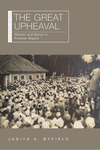
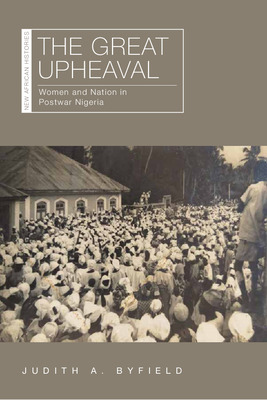
The Great Upheaval: Women and Nation in Postwar Nigeria
Judith A. Byfield
This social and intellectual history of women’s political activism in postwar Nigeria reveals the importance of gender to the study of nationalism and poses new questions about Nigeria’s colonial past and independent future.
In the years following World War II, the women of Abeokuta, Nigeria, staged a successful tax revolt that led to the formation first of the Abeokuta Women’s Union and then of Nigeria’s first national women’s organization, the Nigerian Women’s Union, in 1949. These organizations became central to a new political vision, a way for women across Nigeria to define their interests, desires, and needs while fulfilling the obligations and responsibilities of citizenship. In The Great Upheaval, Judith A. Byfield has crafted a finely textured social and intellectual history of gender and nation making that not only tells a story of women’s postwar activism but also grounds it in a nuanced account of the complex tax system that generated the “upheaval.” Byfield captures the dynamism of women’s political engagement in Nigeria’s postwar period and illuminates the centrality of gender to the study of nationalism. She thus offers new lines of inquiry into the late colonial era and its consequences for the future Nigerian state. Ultimately, she challenges readers to problematize the collapse of her female subjects' greatest aspiration, universal franchise, when the country achieved independence in 1960.Awards: 2023 Aidoo-Snyder Book Prize, 2022 Martin A. Klein Prize in African History
-
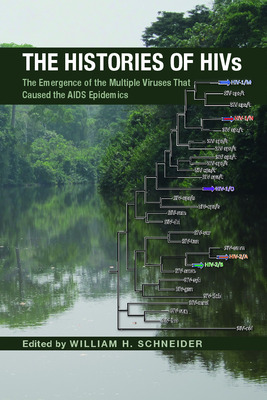
The Histories of HIVs : The Emergence of the Multiple Viruses That Caused the AIDS Epidemics
William H. Schneider
This new collection of essays on HIV viruses spans disciplines to topple popular narratives about the origins of the AIDS pandemic and the impact of the disease on public health policy.
With a death toll in the tens of millions, the AIDS pandemic was one of the worst medical disasters of the past century. The disease was identified in 1981, at the height of miraculous postwar medical achievements, including effective antibiotics, breakthrough advances in heart surgery and transplantations, and cheap, safe vaccines—smallpox had been eradicated just a few years earlier. Arriving as they did during this era of confidence in modern medicine, the HIV epidemics shook the public’s faith in health science. Despite subsequent success in identifying, testing, and treating AIDS, the emergence of epidemics and outbreaks of Ebola, Zika, and the novel coronaviruses (SARS and COVID-19) are stark reminders that such confidence in modern medicine is not likely to be restored until the emergence of these viruses is better understood.
This collection combines the work of major social science and humanities scholars with that of virologists and epidemiologists to provide a broader understanding of the historical, social, and cultural circumstances that produced the pandemic. The authors argue that the emergence of the HIV viruses and their epidemic spread were not the result of a random mutation but rather broader new influences whose impact depended upon a combination of specific circumstances at different places and times. The viruses emerged and were transmitted according to population movement and urbanization, changes in sexual relations, new medical procedures, and war. In this way, the AIDS pandemic was not a chance natural occurrence, but a human-made disaster.
Essays by: Ernest M. Drucker, Tamara Giles-Vernick, Ch. Didier Gondola, Guillaume Lachenal, Amandine Lauro, Preston A. Marx, Stephanie Rupp, François Simon, Jorge Varanda -
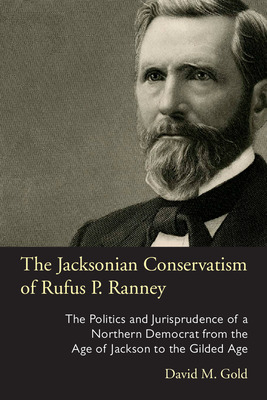
The Jacksonian Conservatism of Rufus P. Ranney The Politics and Jurisprudence of a Northern Democrat from the Age of Jackson to the Gilded Age
David M. Gold
Ohio’s Rufus P. Ranney embodied many of the most intriguing social and political tensions of his time. He was an anticorporate campaigner who became John D. Rockefeller’s favorite lawyer. A student and law partner of abolitionist Benjamin F. Wade, Ranney acquired an antislavery reputation and recruited troops for the Union army; but as a Democratic candidate for governor he denied the power of Congress to restrict slavery in the territories, and during the Civil War and Reconstruction he condemned Republican policies.
Ranney was a key delegate at Ohio’s second constitutional convention and a two-time justice of the Ohio Supreme Court. He advocated equality and limited government as understood by radical Jacksonian Democrats. Scholarly discussions of Jacksonian jurisprudence have primarily focused on a handful of United States Supreme Court cases, but Ranney’s opinions, taken as a whole, outline a broader approach to judicial decision making.
A founder of the Ohio State Bar Association, Ranney was immensely influential but has been understudied until now. He left no private papers, even destroying his own correspondence. In The Jacksonian Conservatism of Rufus P. Ranney, David M. Gold works with the public record to reveal the contours of Ranney’s life and work. The result is a new look at how Jacksonian principles crossed the divide of the Civil War and became part of the fabric of American law and at how radical antebellum Democrats transformed themselves into Gilded Age conservatives.
-
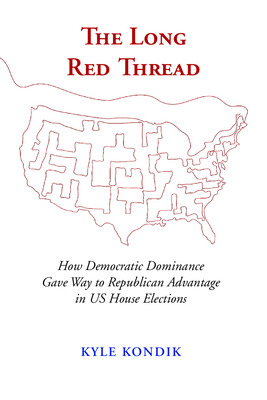
The Long Red Thread : How Democratic Dominance Gave Way to Republican Advantage in US House Elections
Kyle Kondik
An incisive study that shows how Republicans transformed the US House of Representatives into a consistent GOP stronghold—with or without a majority.
Long-term Democratic dominance in the US House of Representatives gave way to a Republican electoral advantage and frequently held majority following the GOP takeover in 1994. Republicans haven’t always held the majority in recent decades, but nationalization, partisan realignment, and the gerrymandering of House seats have contributed to a political climate in which they've had an edge more often than not for nearly thirty years.
The Long Red Thread examines each House election cycle from 1964 to 2020, surveying academic and journalistic literature to identify key trends and takeaways from more than a half-century of US House election results in order to predict what Americans can expect to see in the future. -
The Moxon Tennyson : A Landmark in Victorian Illustration
Simon Cooke
A new perspective on a book that transformed Victorian illustration into a stand-alone art.
Edward Moxon’s 1857 edition of Alfred, Lord Tennyson’s Poems dramatically redefined the relationship between images and words in print. Cooke’s study, the first book to address the subject in over 120 years, presents a sweeping analysis of the illustrators and the complex and challenging ways in which they interpreted Tennyson’s poetry. This book considers the volume’s historical context, examining in detail the roles of publisher, engravers, and binding designer, as well as the material difficulties of printing its fine illustrations, which recreate the effects of painting. Arranged thematically and reproducing all the original images, the chapters present a detailed reappraisal of the original volume and the distinctive culture that produced it. -
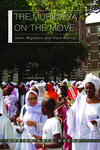
The Muridiyya on the Move : Islam, Migration, and Place Making
Cheikh Anta Babou
Highlights the role of transnational space making in the construction of diasporic Muridiyya identity.
The construction of collective identity among the Muridiyya abroad is a communal but contested endeavor. Differing conceptions of what should be the mission of Muridiyya institutions in the diaspora reveal disciples’ conflicting politics and challenge the notion of the order’s homogeneity. While some insist on the universal dimension of Ahmadu Bamba Mbakke’s calling and emphasize dawa (proselytizing), others prioritize preserving Muridiyya identity abroad by consolidating the linkages with the leadership in Senegal. Diasporic reimaginings of the Muridiyya abroad, in turn, inspire cultural reconfigurations at home.
Drawing from a wide array of oral and archival sources in multiple languages collected in five countries, The Muridiyya on the Move reconstructs over half a century of the order’s history, focusing on mobility and cultural transformations in urban settings. In this groundbreaking work, Babou highlights the importance of the dahira (urban prayer circle) as he charts the continuities and ruptures between Muridiyya migrations. Throughout, he delineates the economic, socio-political, and other forces that powered these population movements, including colonial rule, the economic crises of the postcolonial era, and natural disastersAward: Fage & Oliver Prize.
-
The Papers of Clarence Mitchell Jr., Volume VI : The Struggle to Pass the 1960 Civil Rights Act, 1959–1960
Clarence Mitchell Jr. and Denton L. Watson
The Civil Rights Act of 1960 aimed to close loopholes in its 1957 predecessor that had allowed continued voter disenfranchisement for African Americans and for Mexicans in Texas.
In early 1959, the newly seated Eighty-Sixth Congress had four major civil rights bills under consideration. Eventually consolidated into the 1960 Civil Rights Act, their purpose was to correct the weaknesses in the 1957 law. Mitchell’s papers from 1959 to 1960 show the extent to which congressional resistance to the passage of meaningful civil rights laws contributed to the lunch counter sit-ins in Greensboro, North Carolina, and to subsequent demonstrations. The papers reveal how the repercussions of these events affected the NAACP’s work in Washington and how, despite their dislike of demonstrations, NAACP officials used them to intensify the civil rights struggle.
Among the act’s seven titles were provisions authorizing federal inspection of local voter registration rolls and penalties for anyone attempting to interfere with voters on the basis of race or color. The law extended the powers of the US Commission on Civil Rights and broadened the legal definition of the verb to vote to encompass all elements of the process: registering, casting a ballot, and properly counting that ballot. Ultimately, Mitchell considered the 1960 act unsuccessful because Congress had failed to include key amendments that would have further strengthened the 1957 act. In the House, representatives used parliamentary tactics to stall employment protections, school desegregation, poll-tax elimination, and other meaningful civil rights reforms. The fight would continue.
The Papers of Clarence Mitchell Jr. series is a detailed record of the NAACP leader’s success in bringing the legislative branch together with the judicial and executive branches to provide civil rights protections during the twentieth century.
Printing is not supported at the primary Gallery Thumbnail page. Please first navigate to a specific Image before printing.