

Files
Download Full Text (1.7 MB)
Series
New African Histories
Description
A robust historical case study that demonstrates how village development became central to the rhetoric and practice of statecraft in rural Ghana
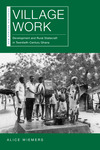
Combining oral histories with decades of archival material, Village Work formulates a sweeping history of twentieth-century statecraft that centers on the daily work of rural people, local officials, and family networks, rather than on the national governments and large-scale plans that often dominate development stories. Wiemers shows that developmentalism was not simply created by governments and imposed on the governed; instead, it was jointly constructed through interactions between them.
The book contributes to the historiographies of development and statecraft in Africa and the Global South by:
—emphasizing the piecemeal, contingent, and largely improvised ways both development and the state are comprised and experienced;
—providing new entry points into longstanding discussions about developmental power and discourse;
—unsettling common ideas about how and by whom states are made;
—exposing the importance of unpaid labor in mediating relationships between governments and the governed;
—showing how state engagement could both exacerbate and disrupt inequities
Despite massive changes in twentieth-century political structures—the imposition and destruction of colonial rule, nationalist plans for pan-African solidarity and modernization, multiple military coups, and the rise of neoliberal austerity policies—unremunerated labor and demonstrations of local leadership have remained central tools by which rural Ghanaians have interacted with the state.
Grounding its analysis of statecraft in decades of daily negotiations over budgets and bureaucracy, the book tells the stories of developers who decided how and where projects would be sited, of constituents who performed labor, and of a chief and his large cadre of educated children who met and shaped demands for local leaders. For a variety of actors, invoking “the village” became a convenient way to allocate or attract limited resources, to highlight or downplay struggles over power, and to forge national and international networks.
Copyright Statement
Village Work © 2021 by Ohio University Press is licensed under Creative Commons License CC BY-NC-ND. To view a copy of this license, visit https://creativecommons.org/licenses/by/4.0/
Language
eng
ISBN
9780821447376
Publication Date
5-28-2021
Publisher
Ohio University Press
City
Athens
Keywords
African history, African states, Alice Wiemers, colonialism and postcolonialism in Africa, communal labor, development in Ghana, economic development in Africa, emerging countries, emerging economies, Kpasenkpe, rural politics in Africa, self-governance in Africa, self-help labor
Disciplines
African History | African Studies | Ethnic Studies | Growth and Development | Political Science
Creative Commons License

This work is licensed under a Creative Commons Attribution-NonCommercial-No Derivative Works 4.0 International License.
Recommended Citation
Wiemers, Alice, "Village Work : Development and Rural Statecraft in Twentieth-Century Ghana" (2021). Ohio University Press Open Access Books. 66.
https://ohioopen.library.ohio.edu/oupress/66
Included in
African History Commons, African Studies Commons, Ethnic Studies Commons, Growth and Development Commons, Political Science Commons